
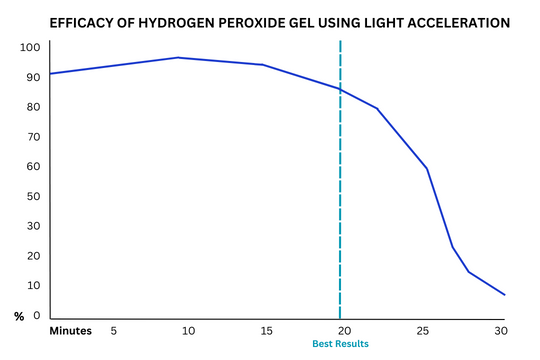
The number of gel application cycles plays an important role in in-clinic teeth whitening because it affects how deeply the whitening gel can penetrate the enamel and target stains.
Professional whitening gel is typically most active during the first 15–20 minutes of each application cycle. During this time, the active ingredients work to break down stain molecules trapped within the enamel. As the gel becomes exhausted or loses potency, its whitening effectiveness begins to reduce.
This is why multiple gel cycles matter.
Each fresh application provides renewed whitening activity, allowing the gel to continue migrating deeper into the enamel and target more stubborn or embedded staining. A treatment with only one short application may remove surface discolouration or brighten the teeth slightly, while multiple professionally timed cycles are designed to achieve deeper whitening and more noticeable results.
Think of it like cleaning a stained surface — one quick wipe may improve the appearance, but repeated treatment is often needed to remove deeper stains in the enamel layer.
Why Professional Grade Teeth Whitening Gel matter
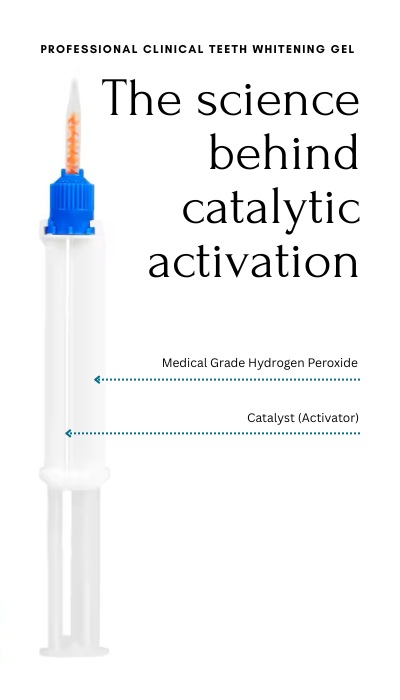
Professional in-clinic catalyst whitening gels work best because they are specifically formulated to deliver a controlled, high-performance whitening reaction under professional supervision. Unlike over-the-counter products, these gels are designed with a higher concentration of active ingredients and are activated in a clinical environment to maximise safety and results.
- A key reason they are more effective is the catalyst activation process. In an in-clinic setting, the gel is applied directly to the teeth and often paired with a specialised light or activation system. This helps accelerate the breakdown of stain molecules trapped within the enamel, allowing the whitening process to work more efficiently and evenly across all teeth.
- Professional catalyst gels are also designed for deep penetration into enamel pores. Tooth enamel contains microscopic structures that hold long-term stains from coffee, tea, wine, and lifestyle habits. When activated correctly, the gel is able to reach these areas and lift discolouration from within the tooth rather than just polishing the surface.
- Another advantage is controlled application cycles. In-clinic treatments allow the gel to be refreshed multiple times during a session, ensuring it remains active and effective throughout the entire appointment. This repeated activation is what helps achieve a more noticeable and longer-lasting whitening result compared to single-application or at-home systems.
- Safety is also a major factor. Professional catalyst gels are used under trained supervision, which means concentration, exposure time, and gum protection are carefully managed. This reduces the risk of uneven whitening or sensitivity while still delivering strong cosmetic results.
- In short, professional catalyst whitening gels work best because they combine:
- stronger formulations
- controlled activation
- repeated application cycles, and
- professional oversight
all of which work together to achieve deeper, more consistent whitening results.
Click the following link to find out more about: Professional Grade Teeth Whitening Gels and how they work?
Compare the Whitening System and Technology
Professional In-Clinic Teeth Whitening Auckland
iSmile Professional In-Clinic Teeth Whitening Auckland offers the most developed, safe and gentle teeth whitening system available on the market today! iSmile Auckland Teeth Whitening Practitioners are fully qualified and registered members of the New Zealand Cosmetic Teeth Whitening Association (NZCTWA). Check out iSmile Teeth whitening treatment options.
Contact us today to schedule an appointment!
Learn more about Professional In Clinic Teeth Whitening Auckland
Follow iSmile on Instagram and Facebook
Go straight to iSmile Online Bookings
Share
MAY
2026
About the Author: